Blog

  • 9 Worst Financial Mistakes People Make and How to Correct Them

    9 Worst Financial Mistakes People Make and How to Correct Them

    We all strive for financial stability and success, yet even the most well-intentioned individuals can make critical mistakes. Whether it’s poor budgeting, investing errors, or failing to plan for the future, these missteps can have a significant impact on our financial well-being. In this blog post, we’ll discuss the nine most common financial mistakes people make and provide practical tips on how to correct them.


    Contents

    Introduction

    I wish I had started to realize the importance of financial literacy 10 or even 20 years earlier.

    “Why weren’t we taught in school?” “If someone had taught me when I was young, I would be in a more comfortable position financially now.” Sometimes, I can’t help to regret doing so little to manage my money in the past.

    Nevertheless, late is always better than never. Even though it would be easier and faster for me to attain financial freedom if I had started earlier, there’s no point crying over spilled milk.

    I’d rather focus on what I can and should do now to make up for the lost time.

    Having realized my past mistakes, I hope others, young people especially, can become financially savvier by avoiding the worst financial mistakes that people commonly make.

    Common Financial Mistakes

    #1 Neglecting Proper Budgeting

    Are you currently following a budget? Do you have a clear understanding of your income and expenses?

    Many people do not have a budget and stick to it. This is one of the most prevalent financial mistakes.

    Without a budget, it’s challenging to manage your money effectively. If you do not have a budget to follow, you may find yourself overspending or struggling to meet financial goals.

    #2 Not Having an Emergency Fund

    Do you have an emergency fund in place to cover unexpected expenses?

    Life is unpredictable. Unexpected emergencies can happen at any time, such as a medical issue, a car repair, or even a sudden job loss.

    If you do not have an emergency fund, you may be compelled to rely on credit cards or loans, which can potentially lead to debt.

    #3 Not Prioritizing Debt Repayment

    Are you actively working on paying off your debts? Do you often carry balances on credit cards?

    When debt lingers without a focused repayment plan, it can accumulate interest and fees over time. Consequently, you will have to pay more than the initial borrowed amount, making it difficult to break free from the debt cycle.

    In particular, high-interest debt like credit cards and personal loans can eat into your finances. Ignoring debt or only making minimum payments can keep you trapped in a cycle of debt.

    Moreover, high levels of debt can have a negative impact on your credit score, affecting your eligibility for loans and favorable interest rates in the future.

    #4 Neglecting Retirement Planning

    Are you actively saving for retirement?

    Retirement may seem far off if you’re young. However, the earlier you start saving, the more time your investments have to grow and the more you can benefit from the snowball effect of compounding interest.

    Neglecting retirement planning can lead to financial insecurity in your golden years. You may find yourself struggling to cover basic living expenses, unable to pursue the activities you’ve dreamed of, and worrying about outliving your savings.

    #5 Overlooking the Importance of Financial Education

    Do you actively seek out financial knowledge and stay informed about personal finance matters?

    Without a solid understanding of personal finance, you’re more susceptible to making poor decisions that could have far-reaching implications.

    By adequately educating yourself about basic financial knowledge, you can manage your money wisely, make informed investment choices, and make strategic decisions to build a strong financial foundation.

    #6 Neglecting Investment

    Are you actively investing for the future?

    Neglecting to invest or not investing enough is a significant financial mistake. Your money can grow significantly through investments. But if you overlook the importance of investment, you will miss the opportunity to harness of the power of compound growth and allow money to work for you while you sleep.

    Investments can play a pivotal role in helping you achieve long-term financial goals, such as funding education, buying a home, or ensuring a comfortable retirement.

    #7 Giving in to Impulsive Buying

    Do you often make impulsive purchases that deviate from your budget?

    Giving in to impulse purchases can disrupt even the most meticulously managed budget. It’s essential to control these urges to ensure you’re not overspending on non-essential items.

    #8 Spending Excessively on Housing and Vehicles

    Do you spend a significant portion of your income on a house or car that may be beyond your means?

    Investing in housing and vehicles may be important, but overspending on these assets can strain your budget and limit your ability to save and invest for the future. High mortgage payments or auto loans can consume a substantial portion of your income, leaving little room for other important financial goals like saving, investing, or emergencies.

    It’s crucial to strike a balance between comfort and affordability to ensure a stable financial foundation.

    #9 Running Up Credit Card Debt

    Do you carry high balances on your credit cards, leading to accumulating interest?

    Credit cards and borrowing can be convenient, but unchecked use can quickly spiral into a cycle of debt.

    Credit cards often come with high interest rates. If you fail to pay your credit card bills promptly, the balance will grow rapidly. Relying on credit cards or frequently borrowing money can lead to a cycle of debt, making it challenging to achieve your financial goals.

    Save for later ⤵️

    worst financial mistakes

    How to Correct Financial Mistakes

    How many of the above describe you? If none of them, congratulations! I envy and admire your financial literacy.

    But if you’re making a few of these mistakes like how I used to be in the past, let’s see how you can correct them:

    #1 Create a Budget and Stick to it

    Start by tracking all of your income and expenses for a few months to get a clear picture of your financial habits. Then, create a comprehensive budget that includes essential expenses, savings, and even some discretionary spending.

    Review and adjust your budget regularly to make sure that you’re on track.

    #2 Set Up an Emergency Fund

    Make it a priority to establish an emergency fund with enough money to cover 3-6 months’ worth of living expenses.

    Keep this fund in a separate account that’s easily accessible but not too tempting for everyday spending. Gradually contribute to it until you reach your goal.

    #3 Prioritize Paying Off Debts

    Create a plan to tackle your debts. First, prioritize paying off high-interest debt, like credit cards while making minimum payments on lower-interest debt.

    Once you’ve paid off one debt, roll the money you were paying on it into the next debt. Known as the “debt snowball” or the “debt avalanche,” this method can help you make significant progress.

    #4 Start Saving for Retirement

    Start contributing to a retirement account as soon as possible. If your employer offers a retirement plan with a matching contribution, take full advantage of it because it’s essentially free money.

    Increase your contributions over time and consider seeking professional advice to ensure your retirement plan aligns with your goals.

    Also, take advantage of this retirement calculator to estimate how much you need to save to retire comfortably, and plan accordingly to achieve your savings goal.

    #5 Educate Yourself About Personal Finance

    Invest time in learning about personal finance. There are numerous resources available, including books, online courses, podcasts, and financial advisors.

    Stay informed about economic trends, investment strategies, and financial planning techniques. The more you know, the better equipped you’ll be to make sound financial decisions.

    #6 Start Engaging in Investment Activities

    Make active efforts to learn about different investment options, such as stocks, bonds, mutual funds, and real estate. Start by investing in low-cost, diversified funds.

    Consider consulting a financial advisor to create a personalized investment strategy based on your risk tolerance, goals, and time horizon.

    Prioritizing investment education and taking calculated steps toward investing can unlock the potential for your money to multiply and secure your financial well-being down the road.

    #7 Implement a Cooling-Off Period

    Before making a purchase, take a step back and evaluate if it aligns with your budget and long-term goals.

    Give yourself a cooling-off period for significant purchases. If you still want the item after a waiting period, it’s more likely to be a conscious decision rather than an impulsive one.

    #8 Place Practicality Above Luxury

    Ensure that your housing costs (including mortgage/rent, property taxes, and maintenance) don’t exceed 25-30% of your monthly income.

    For vehicles, aim to spend no more than 15% of your income on car-related expenses. Prioritize practicality and functionality over luxury to keep these costs manageable.

    #9 Reduce Credit Card Usage

    Create a budget that allows you to pay off credit card balances in full each month. If you have existing credit card debt, allocate extra funds toward paying it down systematically.

    If you must borrow, explore and prioritize lower-interest options, and have a clear repayment plan in place to prevent debt from spiraling.

    Also, take steps to improve your understanding about interest rates, terms, and the impact of debt on your overall financial health. By practicing responsible borrowing and managing credit wisely, you can avoid the pitfalls of debt accumulation and maintain a better financial health.

    Conclusion

    Money management is an essential life skill that we need to secure our current and future financial well-being. Undoubtedly, it’s best to start learning and implementing proper strategies to manage our money at an early age.

    Having said so, it’s never too late to start addressing money matters seriously. Reflect honestly on any financial mistakes we have committed and take active steps to correct them, we’ll be well on our way to a more secure future.


    Have you faced any of these financial challenges? What steps have you taken to correct them? I encourage you to share your thoughts and experiences in the comments below. Your insights could inspire others who are on a similar journey toward financial fitness.

  • Easy Journaling Ideas for Beginners to Cultivate Positivity + Free Printables

    Easy Journaling Ideas for Beginners to Cultivate Positivity + Free Printables

    In the hustle and bustle of everyday life, it’s easy to overlook the small moments that bring us joy and the countless reasons we have to be grateful. Journaling is a powerful tool that can help us slow down, reflect, and cultivate positivity in our lives. If you’re new to journaling, don’t worry – it doesn’t require a background in writing or any special skills. In this blog post, we’ll explore some easy journaling ideas for beginners that can help you embrace a more positive mindset.


    Contents

    Introduction

    I’ve been journaling for two months now. It’s one of the transformative habits that I’ve adopted to reset my life.

    I was inspired to start journaling by two manifestation journals I was designing. In hindsight, it was such a beautifully intuitive experience for me. I’m glad that I heeded my inner calling then.

    Journaling is one of the tools that have helped me stay anchored and positive when life gets a little turbulent. By spending a few moments a day keeping a 369 manifestation journal, I constantly remind myself of the direction I’m heading toward and the goals I strive to achieve.

    It helps me focus on my intentions and actions and avoid distraction.

    Why Should I Keep a Journal?

    In addition to cultivating positivity and gratitude, journaling also offers many benefits that can positively impact various aspects of your life, including:

    #1 – Emotional Release

    Journaling allows you to express your thoughts, feelings, and concerns in a safe and non-judgmental space, helping you process emotions and reduce stress.

    #2 – Self-Discovery

    Journaling encourages self-reflection. As you write about your experiences, goals, and dreams, you gain deeper insights into your thoughts, motivations, and values. This process fosters self-discovery and personal growth.

    #3 – Memory Preservation

    A journal is a wonderful way to capture and preserve memories. Whether it’s documenting milestones, travel adventures, or everyday moments, you’ll create a valuable record of your life that you can revisit in the future.

    #4 – Problem-Solving

    Writing about challenges you’re facing can help clarify your thoughts and find solutions. It’s an effective tool for brainstorming, setting goals, and tracking progress.

    #5 – Creativity

    A journal is a canvas where you can experiment with writing styles, sketches, doodles, and other creative expressions. Keeping a journal helps to nourish your imagination and creativity.

    10 Journaling Ideas for Beginners

    It’s really simple to get started with journaling. Simply grab a pen and a notebook, find a quiet place, sit down, and start to write.

    However, if you’ve never kept a journal before and if you’re not familiar with writing, you may stare at the blank page and be at a loss about what to write.

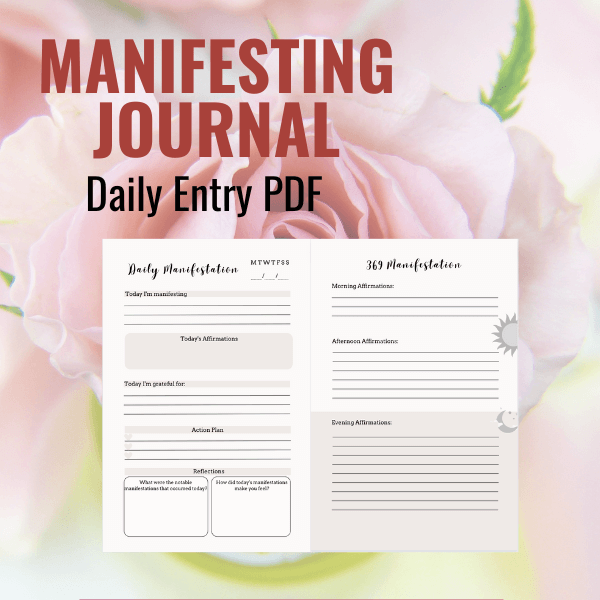
    I had no problem at all when I first started because I used the template and prompts in the manifestation journal I had designed then.

    Download this FREE daily entry PDF to start journaling now! ⤵️

    If you prefer a more comprehensive journaling journey completed with prompts, monthly reviews, and a final reflection section, you may purchase my manifestation journals in PDF format here.

    If you’re looking for other journaling ideas, let’s explore the other 10 popular ways to start journaling:

    #1 – Gratitude Journaling

    One of the simplest and most effective ways to cultivate positivity through journaling is by keeping a gratitude journal.

    Take a few moments every day to reflect and write down three things you’re grateful for. These can be big or small, from a beautiful sunrise to a kind gesture from a friend.

    Over time, this practice helps shift your focus toward the positive aspects of your life, leading to increased happiness and reduced stress.

    #2 – Daily Affirmations

    Affirmations are positive statements that can help boost your self-confidence and improve your overall outlook.

    Start your day by writing down a few affirmations that resonate with you. These can be specific to your goals, such as “I am capable of achieving my dreams,” or more general, such as “I am worthy of love and happiness.”

    Repeat these affirmations to yourself throughout the day and notice how they begin to influence your thoughts and actions.

    #3 – Mindfulness Journaling

    Mindfulness is the practice of being fully present at the moment, and journaling can be a great way to enhance your mindfulness practice.

    Set aside a few minutes each day to write about your experiences and observations. Pay attention to the details – the sights, sounds, and emotions you’re experiencing.

    This type of journaling helps you appreciate the beauty of the present moment and reduces anxiety about the past or future.

    #4 – Positive Reflections

    At the end of each day, take a moment to reflect on the positive moments that occurred.

    Write about a joyful encounter, a personal accomplishment, or even a simple act of kindness you witnessed. Focusing on the positive aspects of your day can help you sleep better and wake up with a more optimistic outlook on life.

    #5 – Vision Journaling

    Use your journal as a space to visualize and plan your future. Write about your goals, dreams, and aspirations. Describe the life you want to create for yourself in vivid detail.

    This exercise not only helps you clarify your goals but also creates a sense of excitement and motivation to work toward them.

    easy journaling ideas for beginners

    #6 – Self-Compassion Journaling

    Being kind to yourself is essential for cultivating positivity. Use your journal as a safe space to practice self-compassion.

    Write about your strengths, accomplishments, and the progress you’ve made, no matter how small.

    When facing challenges or setbacks, remind yourself that it’s okay to make mistakes and that you’re deserving of love and understanding.

    #7 – Creative Expression

    Journaling doesn’t have to be limited to words; it can also be a form of creative expression.

    Doodle, sketch, or paste images in your journal that represent positivity to you. Use colors that evoke happiness and write poems or short stories that uplift your spirit.

    Let your creativity flow freely, and you’ll discover a new way to foster positivity in your life.

    Save for later ⤵️

    easy journaling ideas for beginners

    #8 – Reflect on Lessons Learned

    Every experience, whether positive or challenging, holds valuable lessons. Use your journal to reflect on the lessons you’ve learned from different situations.

    When you encounter obstacles, think about how they’ve helped you grow and what you can take away from those experiences. This perspective shift can turn setbacks into stepping stones toward a brighter future.

    #9 – Random Acts of Kindness

    Make a habit of writing about the kind acts you perform or witness. This could be something as small as holding the door for someone or as significant as volunteering in your community.

    Noting these moments of kindness reinforces the positive impact we can have on others and reminds us of the goodness in the world.

    #10 – Celebrate Small Wins

    In the journey of personal growth, it’s crucial to celebrate your progress, no matter how small it may seem.

    Use your journal to acknowledge and celebrate your achievements, whether it’s completing a task, learning something new, or stepping out of your comfort zone.

    This practice boosts your confidence and encourages you to keep moving forward.

    Fun and Creative Ways to Journal

    Journaling doesn’t have to be a rigid, structured activity. We can make it incredibly enjoyable and creative. Consider these fun and imaginative ideas to make your journaling experience unique:

    #1 – Art Journaling

    Combine writing with art by adding sketches, watercolors, collages, or even washi tape to your journal. Use different colors and textures to express your thoughts visually.

    #2 – Bullet Journaling

    Create a personalized system that combines organization with creativity. Use symbols, lists, and trackers to manage tasks, goals, and habits while adding artistic elements.

    #3- Travel Journal

    Document your adventures by writing about the places you visit, the people you meet, and the experiences you have. Include photos, ticket stubs, and souvenirs for a vibrant travel diary.

    #4 – Prompt-Based Journaling

    Use prompts to guide your writing. Prompts can range from thought-provoking questions to creative writing prompts that encourage storytelling.

    #5 – Gratitude Jar

    Instead of a traditional journal, write down daily moments of gratitude on small slips of paper and place them in a jar. Watch the jar fill up with positivity over time.

    #6 – Free Flow of Thoughts

    Let your thoughts flow freely onto the page without worrying about grammar or structure. This type of journaling can lead to unexpected insights and breakthroughs.

    Final Thought

    Starting a journaling practice is exciting, but it can also be a bit daunting if you’re new to it.

    To get started and stay committed, you may consider finding a journal that makes you excited to write in, incorporating journaling into your daily routine at a fixed time, and creating a comfortable space to write in your journal.

    Nevertheless, remember that there’s no right or wrong way to keep a journal. It’s 100% personal, and feel free to do it in any way you like.

    Find the techniques that resonate with you. Don’t be afraid to experiment with different approaches.

    More importantly, be consistent. Journaling can have a profound impact on your overall well-being, but it takes time to see the full benefits.

    With these easy journaling ideas for beginners, you should be well on your way to cultivating positivity and creating a more optimistic outlook on life.

    Save for later ⤵️

    easy journaling ideas for beginners
  • Retirement Savings: The Magic Number Needed to Retire Comfortably

    Retirement Savings: The Magic Number Needed to Retire Comfortably

    Retirement planning is a universal concern that transcends borders, cultures, and languages. The question of “How much do I need to save to retire comfortably?” echoes across the globe, driving individuals to seek a financial formula that ensures a secure and fulfilling retirement. In this comprehensive blog post, we will dive into the intricacies of retirement savings, explore universally applicable retirement principles, discuss alternative savings strategies, and address the ever-relevant query: Is it ever too late to start saving for retirement?


    Table of Contents

    Introduction

    How much do I need to retire? I wish I had asked this question and taken the initiative to find out the answer in my 20s or 30s.

    Seriously, regardless of your age, and even if you love your job so much that you wish and plan to work until your 80s or 90s, retirement planning is still a must.

    Why? Because there are too many unpredictable things in life, and because there are too many things that are beyond our control.

    For example, we can’t control our life expectancy. I don’t wish to live that long, but what if I live until 100 years old?

    Or, we may enjoy working, but circumstances may change in such a way (e.g. layoff, illness, etc) that we turn out to drop out of the job market.

    Save for later ⤵️

    retirement calculator retirement savings

    Financial Freedom

    Having said that, my definition of retirement is not doing nothing after retiring from my job. Instead, the retirement I aspire for is the freedom from worrying about not having enough money to live if I stop working.

    In other words, by retirement, I mean having enough savings and passive income to live without financial worry even if I don’t receive a paycheck at the end of every month.

    With that financial freedom, I can continue to work if I enjoy it and I can quit at any time if I have other life plans. I will have more financial resilience and flexibility.

    How Much Do I Need to Save?

    How much do I need to save to retire comfortably? This is, no doubt, the million-dollar question.

    But there isn’t a one-size-fits-all answer. The magic number varies because we all have different lifestyles, before and during retirement.

    This sum is influenced by a number of factors, including your present age, desired retirement age, anticipated expenses, and the quality of life you envision post-retirement.

    You may estimate how much you need for retirement with the help of a retirement savings calculator, which takes into account variables like inflation and life expectancy.

    Calculate How Much Retirement Savings You Need

    Retirement Calculator

    Retirement Calculator

    What You’ll Need for Your Retirement

    Common Retirement Rules

    #1 - The 4% Rule

    The 4% rule is a global staple in retirement planning. It involves fairly simple steps to implement: sum up all your retirement savings and investments and withdraw 4% of that sum in the initial year of your retirement.

    In subsequent years, you adjust the withdrawal amount to accommodate inflation. According to the rule, it is highly likely that retirees can sustain their finances for 30 years.

    For instance, for someone with a retirement portfolio totaling $1 million. In the first year of retirement, he/she would withdraw $40,000. Should the inflation and cost of living increase by 2% during that year, you'd grant yourself a 2% raise in the subsequent year, leading to a withdrawal of $40,800, and so forth for the 30 years to follow.

    #2 - The 25x Rule

    This rule adopts a more versatile approach, suggesting that your retirement savings should ideally amount to 25 times your planned annual expenses.

    For example, if you plan to spend $60,000 a year during your retirement, you should have $1.5 million in your retirement assets at the time you retire.

    By focusing on the total nest egg needed, this principle accommodates diverse lifestyles and spending patterns across the world.

    Save for later ⤵️

    retirement calculator to calculate savings needed to retire comfortably

    Do the Retirement Rules of Thumb Work?

    While the 4% Rule and the 25x Rule provide valuable starting points for retirement planning, they are not foolproof strategies. Both rules come with caveats that require careful consideration.

    Limitations of the 4% Rules:

    • Inflexible Assumptions: The rule assumes rigid annual spending increases based on inflation, not considering variations in portfolio performance or changes in expenses.
    • Market Uncertainty: Future market returns may differ from historical averages used in the rule's calculation, impacting the sustainability of the withdrawal rate.
    • Portfolio Allocation: The rule applies to a portfolio with 50% stocks and 50% bonds; deviations from this allocation may require adjustments.
    • Retirement Length: The rule assumes a 30-year retirement horizon, underestimating the needs of retirees with longer life expectancies.

    Limitations of the 25x Rules:

    • Variability of Expenses: It assumes consistent annual expenses throughout retirement, not accounting for potential fluctuations in spending.
    • Market Performance: Similar to the 4% Rule, the rule relies on historical market returns, which may not accurately predict future returns.
    • Assumption of Infinite Withdrawals: While the rule suggests indefinite sustainability, real-world market conditions and personal circumstances can impact long-term withdrawals.
    • Retirement Length: Like the 4% Rule, it might not fully accommodate retirees with life expectancies exceeding 30 years.

    Save for later ⤵️

    Retirement savings calculator

    Is It Too Late to Start?

    Did the "magic number" estimated using the retirement savings calculator take you by surprise? Does the number make you wonder if you have enough savings to retire and if it's too late to start saving?

    It's true that the earlier we start, the benefits of compound interest will be more pronounced. However, there's no need to panic even if you started late or haven't started at all.

    Instead, explore proactive steps you can take to speed up your savings and make up for lost time. Here are some ideas for you to consider:

    #1 - Trim Spending to Free Up Cash

    Making minor adjustments such as dining out less, prioritizing sale items, driving less, or considering downsizing your home can help you free up cash for savings. Consider these 7 saving tips to help you save effectively.

    #2 - Prioritize Paying Off High-Interest Debts

    Becoming debt-free is crucial for a comfortable and worry-free retirement. Therefore, making plans to pay off your debts, especially those incur a high interest, should be a priority. Here is a list of small habits you can develop to free up cash for this purpose.

    #3 - Consider Increasing Risk to Compensate for Lost Time

    If you're in a comfortable financial position, you may consider increasing risk, a financial adviser suggested. This might involve having a higher proportion of stocks in your investment portfolio compared to stable assets like bonds. However, if you're not prepared for the market's ups and downs, avoid investing in riskier assets.

    Although investing in stocks may potentially amplify your returns, keep in mind that high risk doesn't always guarantee high returns; it can also lead to losses.

    #4 - Supplement Your Retirement Savings With Side Hustles

    A side hustle is a flexible, part-time gig or venture that you can pursue alongside your main job or even during retirement. It's a fantastic way to supplement your retirement fund and increase your financial resilience.

    Side hustles provide an additional income stream, allowing you to put aside extra money for retirement or cover unexpected expenses.

    The beauty of side hustles is their flexibility. You can choose opportunities that align with your skills, interests, and available time. It could be freelancing, blogging, consulting, selling handmade crafts online, tutoring, driving for ride-sharing services, pet sitting, or even participating in the sharing economy.

    By dedicating a portion of the income generated from your side hustle directly to your retirement fund, you can significantly accelerate your savings. Moreover, some side gigs even have the potential of generating passive income in the long run.

    Conclusion

    Nevertheless, it's important to remember that no single retirement rule or magic number can perfectly predict every individual's unique circumstances.

    Retirement planning is a dynamic process that requires ongoing adjustments based on changes in lifestyle, market conditions, and personal goals.

    The key takeaway is that it's never too late to start. Whether you're in your 20s, 50s, or any age in between, the decisions we make today can significantly impact our retirement years.

    By understanding our financial goals, exploring various saving strategies, and seeking professional advice, we can work towards achieving the retirement we aspire to, even if we feel like we've started late.

    Disclaimer: Please note that the information provided in this blog post is intended for general informational purposes only. The content is not intended to be a substitute for professional financial or retirement planning advice.

  • Gratitude Quotes: 22 Best Quotes to Inspire Appreciation and Happiness

    Gratitude Quotes: 22 Best Quotes to Inspire Appreciation and Happiness

    Life’s challenges may test us, but amidst the chaos, there is a beacon of light waiting to be found in the art of being thankful. This blog post explores the transformative power of gratitude and 22 unique gratitude quotes that can lift our spirits and infuse our days with appreciation and happiness.


    Jump to

    Recently, I faced a bathroom crisis when a hose burst, causing a water deluge. As I scrambled to find a solution, an unexpected hero emerged, reminding me of the importance of gratitude in the face of adversity.

    Power of Gratitude

    Research has confirmed that gratitude makes us happier.

    Gratitude is a powerful emotion that can transform our perspective. It is the practice of acknowledging and appreciating the good things we have, even in the midst of challenging situations.

    As American author Melody Beattie aptly pointed out, “Gratitude turns what we have into enough.”

    In moments of difficulty and despair, finding gratitude can be a lifeline that pulls us out of negativity and allows us to see the silver linings.

    The experience with the burst hose in my bathroom was a perfect example of how gratitude can shift our mindset and bring joy even in times of crisis.

    It is easy to get caught up in the frustrations and inconveniences of life, but if we take a moment to pause and reflect, we will often find that we have so much to be thankful for.

    Expressing gratitude not only allows us to stay positive but also has numerous mental and physical health benefits. Research has shown that practicing gratitude can reduce stress, improve sleep, increase empathy, and boost overall well-being.

    Gratitude Quotes to Appreciate

    Now I’d like to share with you 22 beautiful gratitude quotes that can inspire appreciation and happiness.
    1. “Gratitude can transform common days into thanksgivings, turn routine jobs into joy, and change ordinary opportunities into blessings.” – William Arthur Ward

    gratitude quotes

    2. “Acknowledging the good that you already have in your life is the foundation for all abundance.” – Eckhart Tolle

    3. “Gratitude makes sense of our past, brings peace for today, and creates a vision for tomorrow.” – Melody Beattie

    4. “Gratitude is not only the greatest of virtues but the parent of all others.” – Marcus Tullius Cicero

    5. “When you are grateful, fear disappears, and abundance appears.” – Tony Robbins

    gratitude qutoes

    6. “Gratitude is the sign of noble souls.” – Aesop

    7. “The more grateful I am, the more beauty I see.” – Mary Davis

    8. “Gratitude is the wine for the soul. Go on. Get drunk.” – Rumi

    9. “Gratitude is a powerful catalyst for happiness. It’s the spark that lights a fire of joy in your soul.” – Amy Collette

    10. “Gratitude is the fairest blossom which springs from the soul.” – Henry Ward Beecher

    gratitude qutoes

    11. “Gratitude unlocks the fullness of life.” – Melody Beattie

    12. “Gratitude is the healthiest of all human emotions. The more you express gratitude for what you have, the more likely you will have even more to express gratitude for.” – Zig Ziglar

    Quotes About Appreciation and Gratitude

    13. “Gratitude is the open door to abundance.” – Harbhajan Singh Yogi

    14. “Gratitude turns what we have into enough, and more. It turns denial into acceptance, chaos into order, confusion into clarity.” – Melody Beattie

    gratitude qutoes

    15. “Gratitude is the music of the heart, when its chords are swept by the breeze of kindness.” – Unknown

    16. “Gratitude is a currency that we can mint for ourselves, and spend without fear of bankruptcy.” – Fred De Witt Van Amburgh

    17. “Gratitude is the sweetest thing in a seeker’s life – in all human life. If there is gratitude in your heart, then there will be tremendous sweetness in your eyes.” – Sri Chinmoy

    gratitude qutoes

    18. “Gratitude will shift you to a higher frequency, and you will attract much better things.” – Rhonda Byrne

    19. “Gratitude helps you to grow and expand; gratitude brings joy and laughter into your life and into the lives of all those around you.” – Eileen Caddy

    20. “Always remember people who have helped you along the way, and don’t forget to lift someone up.” – Roy T. Bennett

    21. “Living in a state of gratitude is the gateway to grace.” – Arianna Huffington

    gratitude and appreciation quotes

    22. “Cultivate the habit of being grateful for every good thing that comes to you, and to give thanks continuously. And because all things have contributed to your advancement, you should include all things in your gratitude.” – Ralph Waldo Emerson

    Cultivate Happiness With Gratitude Quotes

    These gratitude quotes remind us of the immense power of gratitude and the happiness it brings into our lives. Here are some suggestions on how we can make use of them to infuse positivity, appreciation, and happiness into our lives:

    #1 – Daily Affirmations

    Turn a gratitude quote that resonates with you into a daily affirmation. Recite it each morning to set a positive tone for the day and remind yourself to be grateful for the blessings in your life.

    #2 – Gratitude Journal

    Create a gratitude journal where you jot down these quotes alongside your reflections on what you are thankful for each day.

    #3 – Meditation and Reflection

    Incorporate these quotes into your meditation practice. Take a few moments of mindfulness to contemplate their meanings and embrace the feelings of gratitude that arise within you.

    #4 – Share with Others

    Spread the power of gratitude by sharing these quotes with friends, family, or colleagues. You never know who might benefit from a dose of inspiration and positivity in their day.

    #5 – Create Visual Reminders

    Turn your favorite gratitude quote into a beautiful piece of art or a screensaver for your devices. Surround yourself with these visual reminders to reinforce the importance of gratitude in your life.

    #6 – Social Media Posts

    Share these quotes on your social media platforms to inspire and uplift your friends and online community. Encouraging others to practice gratitude can create a ripple effect of positivity.

    Be Thankful and Happy

    Let’s make it a habit to cultivate gratitude daily. With a grateful heart, you will find that even in the face of challenges, there is always something to be thankful for.

    Embracing gratitude as a daily practice can lead to a happier, more fulfilling existence, and inspire others to do the same.

    Having said that, gratitude is not just a fleeting emotion; it is a life-changing mindset that can transform the way we experience the world around us.


    I’d like to hear from you! Please share your thoughts and favorite gratitude quotes in the comments below. Let us build a community of appreciation and inspire one another to embrace gratitude in our daily lives.

    Save for later ⤵️

    gratitude qutoes
  • Passive Income: How to Make Money While You Sleep

    Passive Income: How to Make Money While You Sleep

    In today’s fast-paced world, the concept of passive income has gained immense popularity. Passive income refers to the money earned regularly with minimal effort and active involvement. Unlike traditional jobs, where you trade time for money, passive income allows you to generate revenue even while you sleep. This article explores what passive income is and presents a range of ideas for different age groups and people with different expertise.


    Contents

    Yoko Sano, the author of the famous Japanese picture book The Cat That Lived a Million Times, wrote in an essay that she rejoiced when her doctor told her that she had only 2 years left.

    She walked into a Jaguar shop and bought a new Jaguar.

    Why? Because now she knew she was going to die in 2 years, she didn’t have to worry about money anymore.

    As a freelance writer and illustrator, she didn’t have a pension. She was always worried about not having enough money in case she lived until 90.

    So she always worked hard to save money until her doctor told her the diagnosis when she was 70.

    I can totally relate to her worry because I’m also a freelancer.

    Why Do We Need Passive Income?

    But even if you aren’t freelancing and even if you have solid savings, once you retire or lose your source of income, wouldn’t you feel worried seeing that your money only flows in one direction?

    I know I would hesitate to spend if my money only flows out and not in. Budgeting is hard because I don’t know how long I will live.

    I learned the concept of passive income quite late. But late is always better than never.

    Now I understand that passive income is always a good idea regardless of your profession, how much you earn, and how much you’ve saved.

    Whether you’re aiming to earn extra money to achieve whatever financial goals or retire without financial worries, you should consider finding ways to generate some passive income.

    Saving money is important, but savings alone is not enough. A smart money management strategy involves the aspects of frugality, building up your savings, as well as increasing your income.

    What is Passive Income?

    Passive income is income that comes in regularly with little or no direct effort required from the earner. We may generate a passive income from various sources, including investments, real estate, online businesses, and creative pursuits.

    It is different from active income, which we receive from an employment or business venture that requires our active and continuous participation and efforts.

    Common examples of passive income include interest on savings, rental received from leasing out a property, and stock dividends.

    The key idea behind passive income is to set up income streams that require an initial investment of time, money, or both and then continue to generate income with minimal involvement once those income streams are established.

    In essence, passive income is not necessarily easy and fast money. In fact, oftentimes, it generates little or no money at all when we first start out.

    It’s like sowing a seed, and before we can enjoy the fruits, we need to take care of our tree consistently. However, once your tree starts to bear fruits, you’ll get to reap the fruits for many years to come.

    Think long-term, when it comes to passive income.

    Save for later ⤵️

    passive income ideas

    24 Passive Income Ideas

    For Students

    #1 – Rent out textbooks or study materials to fellow students

    Utilize your course materials to help others while earning some extra cash. Renting out textbooks or study guides to fellow students can be a convenient and affordable option for them while generating passive income for you.

    #2 – Start a blog or YouTube channel about study tips and monetize it

    Share your academic expertise and insights by creating a blog or YouTube channel. Attract an audience with engaging content and useful study tips, and you can monetize your platform through advertisements or affiliate partnerships.

    #3 – Create digital study guides and sell them online

    Compile your comprehensive study notes into digital study guides and offer them for sale on online platforms. As students search for helpful resources, your guides can become a valuable asset, earning you passive income.

    #4 – Participate in online surveys or market research studies

    Many research companies offer compensation for participating in surveys or market research studies. Dedicating some spare time to these activities can earn you some extra money.

    For Stay-at-Home Parents:

    #5 – Start a parenting blog and monetize it

    Share your parenting experiences, tips, and advice through a blog. You can monetize your blog through advertisements, sponsored posts, and affiliate marketing by attracting a dedicated readership.

    #6 – Create and sell digital products

    Leverage your creativity to develop digital products that appeal to other parents. You can generate passive income by selling printable kids’ activities, parenting guides, or helpful resources online.

    #7 – Rent out a spare room

    If you have a spare room in your home, you can rent it out or list it on short-term rental platforms like Airbnb. Hosting guests can provide a steady stream of passive income.

    #8 – Become a virtual assistant or offer freelance services

    Utilize your skills from home by becoming a virtual assistant or offering freelance services like graphic design or writing. You can find clients via platforms like Upwork or Fiverr. Freelancing is a way to earn money on a flexible schedule.

    For Artists or Creatives:

    #9 – Sell digital artwork, illustrations, or photography

    Make money with your artistic talents by showcasing and selling your creations on stock image websites. Each sale can earn you passive income as your portfolio grows.

    #10 – Create and sell digital design assets

    Designers can create and sell digital assets like fonts, icons, or templates on marketplaces. As customers purchase your products, you’ll earn passive income without ongoing effort.

    #11 – Publish an e-book or online course

    Share your knowledge and expertise by publishing an e-book or creating an online course. Platforms like Amazon Kindle and Udemy allow you to reach a global audience and generate income from your creative expertise.

    #12 – License your music for use in videos, podcasts, or commercials

    If you are a musician or composer, consider licensing your music for various media projects. Each time your music is used, you’ll earn royalties.

    For Retirees:

    #13 – Invest in dividend-paying stocks or REITs for regular income

    Diversify your investment portfolio by investing in dividend-paying stocks or Real Estate Investment Trusts (REITs). These investments can provide a reliable source of passive income during retirement.

    #14 – Rent out a property or a room in your home

    If you have extra properties or space, capitalize on them by renting out your properties. Alternatively, you can consider renting out your rooms on platforms like Airbnb.

    #15 – Create an online store selling vintage or collectible items

    Turn your passion for collecting into a profitable venture by setting up an online store. Selling vintage or collectible items can be an enjoyable way to generate extra income.

    #16 – Invest in a peer-to-peer lending platform

    Explore peer-to-peer lending platforms as an alternative investment option. By lending money to individuals or small businesses, you can earn interest and receive regular passive income.

    For Programmers or Tech Enthusiasts

    #17 – Develop and sell mobile apps or software

    If you have programming skills, consider creating and selling mobile apps or software. Once developed, your products can generate passive income through sales and updates.

    #18 – Create a YouTube channel or blog about tech reviews

    Share your tech expertise through video content or blog posts. As your channel or blog gains popularity, you can monetize it through advertisements, affiliate marketing, and sponsorships.

    #19 – Invest in cryptocurrencies and earn through staking or yield farming

    Engage in the world of cryptocurrencies by investing in projects that offer staking or yield farming rewards. As you hold and stake your coins, you can make money through interest or rewards.

    #20 – Start an online tech course and earn through course sales

    Share your tech knowledge by creating and selling online tech courses. Platforms like Udemy and Coursera enable you to reach a wide audience and make money from course sales.

    For Travelers

    #21 – Create a travel blog and monetize it

    Document your travel experiences through a blog and monetize it by incorporating advertisements, affiliate marketing, and sponsored content from travel-related companies.

    #22 – Rent out your home or property while you’re traveling

    While traveling, rent out your home or property on platforms like Airbnb to earn money while exploring the world.

    #23 – Write and publish travel guides or e-books

    Share your travel knowledge by writing and publishing travel guides or e-books. These digital products can provide passive income long after your adventures are over.

    #24 – Become a travel photographer and sell your images on stock photography platforms

    If you have a talent for photography, capture stunning travel images and sell them on stock photography websites. Each sale can bring in passive income as your portfolio grows.

    Conclusion

    Passive income offers an attractive way to achieve financial freedom. By diversifying your income streams, you can create a reliable foundation for a more secure future.

    We can create as many income streams as we like, but considering the constraint of time and resources that face most of us, I believe that it’s better to start with one or two endeavors in the beginning.

    You may explore other ideas once your initial initiative(s) becomes established.

    While passive income ideas with little or no investment may seem easier, they often require consistent effort and time to build an audience or gain traction.

    On the other hand, passive income ideas that involve financial commitment can potentially yield substantial returns over the long term.

    Nevertheless, as with any financial endeavor, it is essential to do your research and seek professional advice if needed.

    Passive income can be a powerful tool to create financial security and abundance, enabling you to make money while you sleep.

  • Pinterest Keyword Research: Tips That Will Blow Your Mind

    Pinterest Keyword Research: Tips That Will Blow Your Mind

    As a powerful search engine and a popular social media platform, Pinterest offers immense opportunities for bloggers and content creators to drive traffic, expand their audience, and ultimately make money. In this article, I will share five powerful research methods to find Pinterest keywords and bonus tips for organizing and using the keywords discovered using those techniques.


    Contents

    As beginner bloggers, even if monetization is our ultimate goal, it’s almost inevitable that we have to deal with a brutal truth: blogging is NOT a quick money scheme. As a powerful search engine and a popular social media platform, Pinterest offers immense opportunities for bloggers and content creators to drive traffic, expand their audience, and ultimately monetize their efforts. In this article, we will explore the significance of Pinterest keywords and how they can play a crucial role in boosting your blog’s visibility, engagement, and success on this dynamic platform.

    Some bloggers out there may have claimed that they started to make money blogging within a month or even faster. That may be the case for them, but I highly doubt that it’s a common phenomenon.

    For most content creators who are not celebrities, in the first few months (at least!), a likelier scenario is that almost nobody reads our posts or watches our videos.

    It’s like basking on the street, but no one stops by to listen to us. Yet, to finally get an audience, we still have to keep singing as if we’re singing in a full-house concert.

    If we stop and give up, we’ll never get any audience.

    Blogging for Money: Content and Web Traffic

    We need to set realistic short-term goals to keep us going in the long run until we finally find our audience.

    It is to avoid disappointment when our (unrealistic) expectations are not met.

    Let’s be pragmatic. Before we can actually monetize, let’s focus on what we can do and should do first.

    In the first few months, we should focus on enriching our blog content and finding ways to increase web traffic. These are the two essential aspects of monetizing our blogs.

    Increase Blog Traffic

    As far as the topic of growing blog traffic is concerned, there are many suggestions. Again, there are too many that we, the beginners who have a limited budget to spend on our blogs and may have to do all the work on our own, may feel overwhelmed.

    That’s why when I made a plan to start a blog, I decided to focus my time and energy on SEO and Pinterest as my main strategies to drive traffic to my blog.

    It’s generally estimated that SEO efforts will take, on average, 6 to 12 months to see the results.

    How to blog consistently with little visibility for 6 to 12 months? It’s challenging, if not tormenting.

    For this reason, besides SEO, I need other strategies. And Pinterest is my primary choice.

    How to explode a new and small Pinterest account

    Why Pinterest?

    But why Pinterest?

    I prefer Pinterest over popular social media platforms like Facebook, Twitter, Instagram, Tik Tok, etc, for the following reasons.

    First, Pinterest is more a search engine than a social media platform. This means that the content you post on Pinterest has a much much longer lifespan than posts on Facebook, Twitter, and other social media platforms.

    In fact, a search for a certain topic or keyword on Pinterest often generates results that lead us to blog posts published a few years ago. While it’s possible that people create new pins for their old content, it’s also possible that those are pins that have been around for quite a while. Old pins are still visible after several years, and it’s likely that their visibility and popularity have been growing over time.

    Second, with 463 million people using Pinterest every month, Pinterest is one of the most popular social media platforms, giving me opportunities to reach a vast audience.

    Third, Pinterest’s board system helps in organizing and categorizing content, which can improve the chances of my content being found in search engines.

    Fourth, data shows that 83% of Pinterest users have completed a purchase influenced by the content they saw on Pinterest. So for bloggers who aspire to make money through affiliate marketing, Pinterest is a platform that must not be overlooked.

    The last reason is purely personal. I’ve tried to cut down my usage of social media for a few months now (Facebook in particular because I’ve never been active on other social media). So if there’re other ways, I’d avoid resorting to social media first.

    Save for later ⤵️

    Pinterest keyword research

    Why is Pinterest Keywords Important?

    Keywords play a vital role in driving more traffic to a blog through Pinterest. As you probably have known already, Pinterest is a search engine. Therefore, Pinners often conduct searches to find inspiration, ideas, or products. Including well-researched keywords will help our pins rank higher in these search results.

    Additionally, using popular keywords helps tap into trending topics, increasing the likelihood of content going viral. Viral pins have the potential to reach a vast audience, leading to a significant boost in traffic and potentially attracting new followers.

    Furthermore, Pinterest’s Smart Feed algorithm rewards high-quality and engaging content. Using relevant keywords can help us increase the engagement rates and subsequently, exposure and traffic to our blogs.

    How To Do Pinterest Keyword Research?

    In this section, I’m going to show you several ways to effectively conduct keyword research on Pinterest, without using any paid tools.

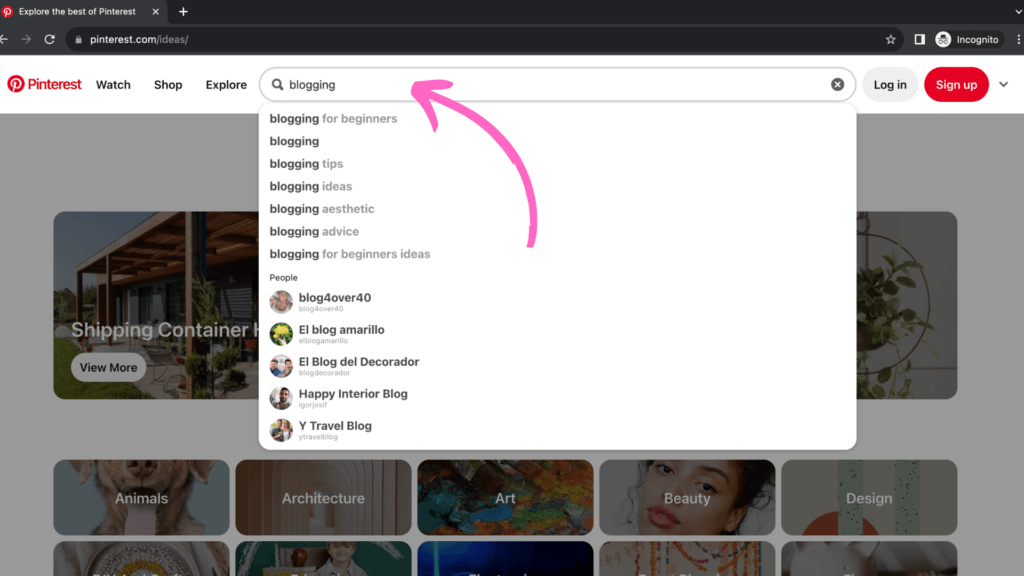
    Probably the most common and straightforward method. On the Pinterest Business Hub page, when you click the magnifier icon on top of the page, a gray search bar will appear. Simply type in a general search word or term, but do not click “enter.” You’ll see a list of suggested/related search terms, including some long-tail keywords, and Pinterest profiles that have the same or related words in their profile name.

    In my example, by typing “blogging” in the search bar, I found 5 other related keywords.

    Method 2: Pinterest Keyword Bubbles

    Also on the same page, if I hit the “enter” button to conduct the search, besides pins related to the search term “blogging,” we will also see a row of colorful keyword bubbles under the search bar showing a number of related keywords.

    Pinterest Keyword Research

    Clicking those keyword bubbles will lead to more keywords.

    For example, clicking the “how to start a” bubble generates more keyword bubbles. In this way, we’ve found a list of long-tail keywords related to the topic “blogging”:

    • How to start a blog
    • How to start a blog for beginners
    • How to start a blog and make money
    • How to start a blog for beginners free
    • How to start a blog in 2023
    • How to start a blog for free
    • How to start a blog for beginners step by step
    • How to start a blog for beginners ideas

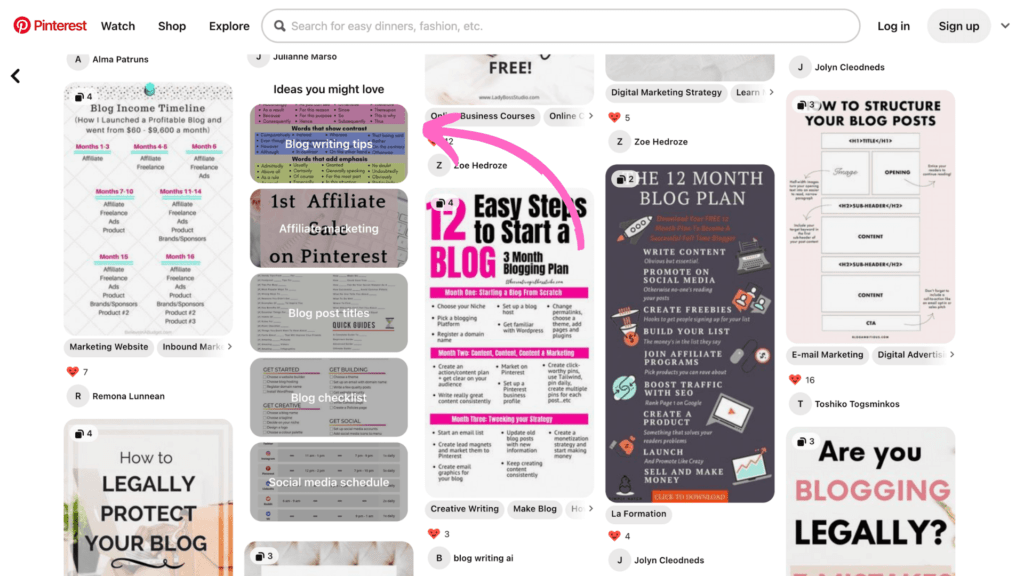
    If you scroll down, you’ll find several grayed-out boxes somewhere further down the page, as shown in the picture below. Here you’ll see several more related keywords.

    Pinterest Keyword Research

    On the Pinterest Business Hub page, click the “Analytics” button on the top left and select “Trends” from the drop-down list. It will lead us to the Pinterest Trends page.

    Scroll down and you’ll see the word “Keywords” on the left sidebar. Click the arrow in the box and a search box will appear.

    When I type “blogging” in the search bar, it shows me the trends of “blogging for beginners.”

    Clicking “blogging for beginners” takes me to the page shown below. On that page, I can type other keywords to compare the trends.

    Scrolling down a little, we’ll see several gray bubbles showing related keywords. We may click these bubbles to compare how these keywords trend on Pinterest.

    Method 5: Pinterest Explorer

    When I came across this Pinterest Keyword research technique (and a couple of other techniques) on Leah Marie Marketing, they simply blew my mind!

    I had read quite a lot concerning this topic, but no one talked about these ingenious and hidden tactics.

    Let’s dive in!

    Leah recommends searching in an incognito mode when employing this method. I believe that it’s to generate neutral results, as opposed to search results influenced by our previous browser activity data.

    So open a new incognito window and go to the Pinterest Explorer page.

    Pinterest Keyword Research

    Do not log in. Instead, type a general keyword in the search bar. Similar to the Pinterest search bar method, a list of related keywords and profiles will appear if you do not hit “enter” right away.

    Pinterest Keyword Research

    When I hit “enter,” the search results show a number of popular pins.

    Pinterest Keyword Research

    Click on any of the pins, and you’ll see a string of gray keyword bubbles under the profile of the pin creator. Click the arrow sign at the right end, and you’ll find more related keywords.

    Not only that, scroll down the page, and you’ll find more strings of keyword bubbles all over the page.

    In addition to those small gray keyword bubbles, similar to Method #3, if you scroll further down the page, you will see grayed-out boxes containing more related keywords.

    Pinterest Keyword Research

    Leah has a few other genius ideas about how to find keywords on Pinterest, head over to her blog to find out more. For me, I’ve gathered a ton of keywords using these 5 techniques.

    Where To Put Pinterest Keywords?

    How should we use the keywords we’ve found on Pinterest for optimization and traffic generation?

    It’s recommended to add keywords in the following 9 places as the best practice of Pinterest SEO:

    • Pinterest Profile
    • Board Titles
    • Board Descriptions
    • Pin Titles
    • Pin Descriptions
    • Texts Overlay on Pin Images
    • File Names of Your Pins
    • Meta Descriptions of Your Blog Posts
    • Alt Texts of Pin Images

    Nevertheless, avoid keyword stuffing. Rumor has it that search engines are not fond of the behavior. We don’t want to get penalized for committing the offense.

    Bonus Tips: How to Organize Pinterest Keywords Efficiently?

    So we know how to find keywords on Pinterest, in fact, a large amount of keywords. For example, by using the above methods, I found 150 keywords related to “journaling.” And my research is far from exhaustive.

    But the keywords we found are not organized. They are messy. To put them into use effectively, we need to organize them into categories, which can be quite a headache.

    Fortunately, now we can seek help from artificial intelligence.

    So this is how I organized my keywords. First, I opened a new spreadsheet on Google Drive (you may use Excel if you like to). I keyed in all the keywords I found in the spreadsheet.

    When I found enough keywords, I copied those keywords to Chat GPT and asked it to group the keywords into different categories. With its powerful data analysis capability, it completed the categorization in a blink of an eye.

    In addition, I also asked Chat GPT to draft pin titles and pin descriptions using the keywords I found. Although I may not necessarily like its writing, those texts are good starting points and references. I will then edit or mix and match to add more humanity, authenticity, and uniqueness to the titles and descriptions.

    Check out and save the diagram below for Chat GPT prompts that you can use to organize and use your Pinterest keywords. ⤵️

    chat GPT for pinterest keywords

    I hope this guide has shed light on the importance of Pinterest keywords and how they can elevate your blog’s performance on the platform. Now, it’s your turn! I would love to hear your thoughts and experiences with utilizing Pinterest keywords. Have you seen significant improvements in your traffic and engagement? Do you have any additional tips or techniques to share? Leave your valuable insights in the comments section below, and let’s continue the conversation.